Skip to Content Skip to main content Skip to content
Showroom hours

ADP registered vendor. Help with ODSP, March of Dimes, WSIB, VA and IFHP. ADP registered vendor. See if you qualify

Free in-home assessment across Toronto and the GTA. Free in-home assessment. Book a visit

Visit our showrooms in Etobicoke and Brampton. Showrooms in Etobicoke and Brampton. Find us

Service and repairs by our own team, at home or in store. Repairs by our own team. Request a repair

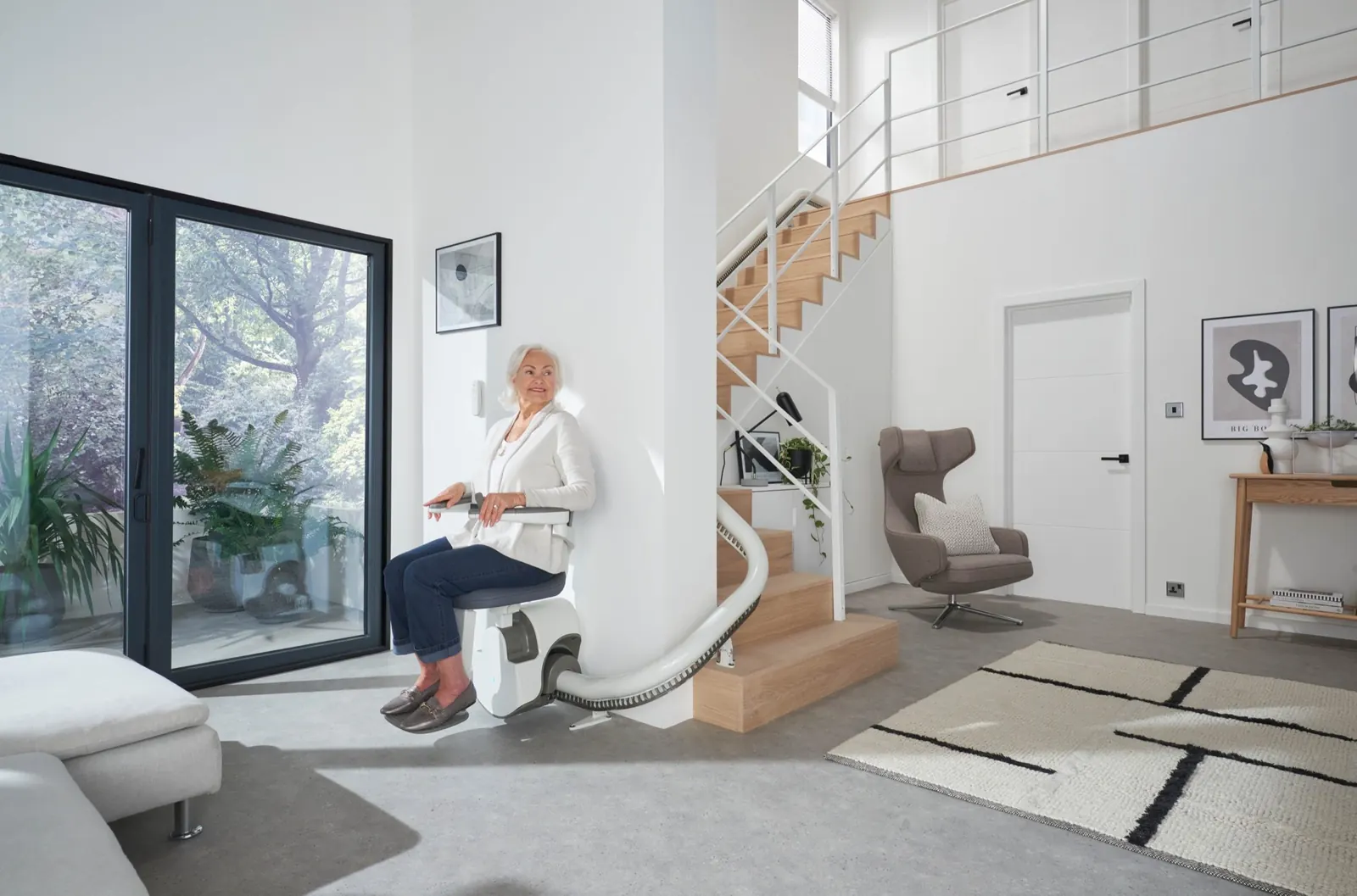
A woman seated on an Access BDD Flow X stairlift beside a turning oak staircase in a bright, open living room.

Curved stairlifts in Toronto, made for the turns in your stairs

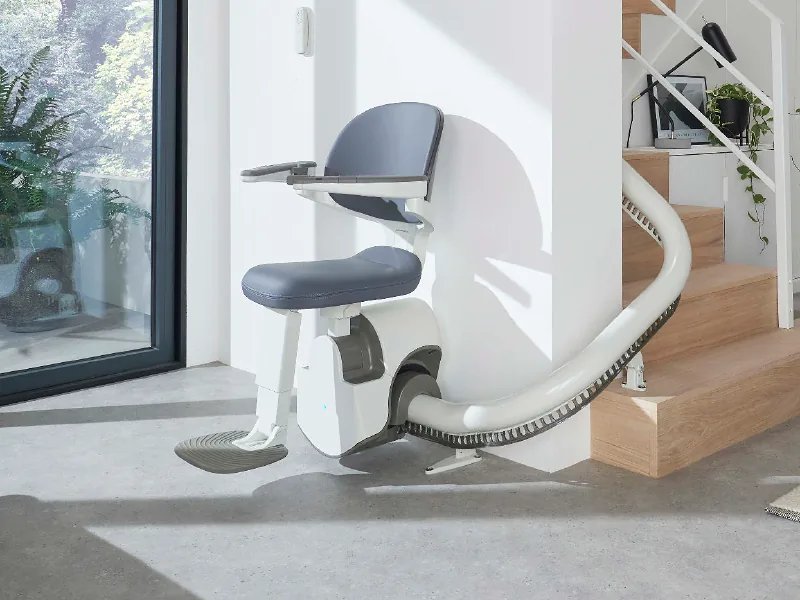
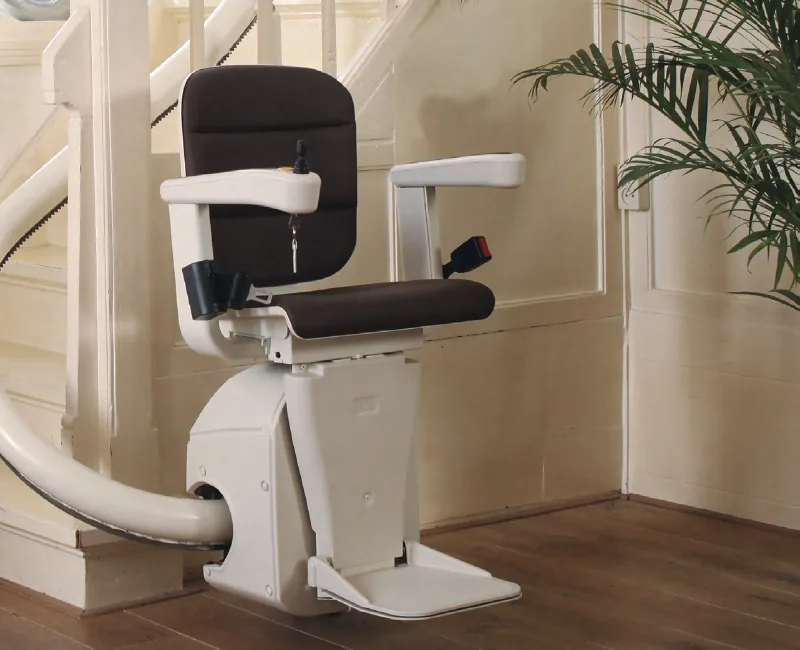
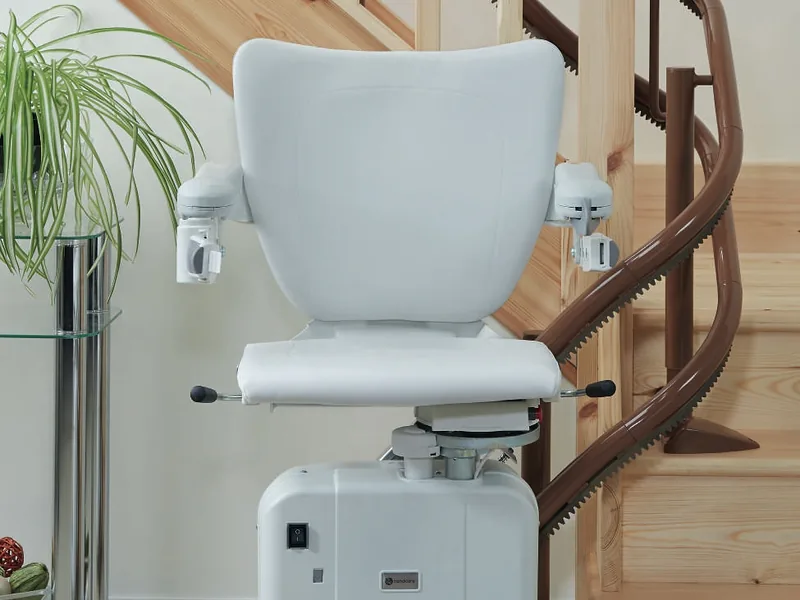
A curved rail is built for one staircase, so we start with yours. We install the Access BDD Flow X and the Handicare Freecurve. For a rider who needs a Handicare 2000, we can ask Savaria about a special order and confirm it first.

  • Free home assessment and a written quote
  • Nothing is ordered until you approve the quote
  • Showrooms in Etobicoke and Brampton
Only have a question, like the cost? Ask it here
Start with your stairs

Your staircase picks the lift, so we start there

Five questions you can answer standing at the bottom step. The suggestion changes as you go, and we confirm it with a tape measure at your home. Not sure about one? Pick Not sure.

Compare the three curved lifts we install. Our team helps you choose at the free home assessment.

Book a free assessment
Side by side

The three lifts, in the makers' own figures

Published figures. We check every figure against your stairs at the free assessment.

Curved stairlifts we install: model differences
What to compareAccess BDD Flow XHandicare FreecurveHandicare 2000
StatusCurrent modelCurrent modelSpecial order, confirm first (discontinued)
RailOne round 80 mm rail, fixed to the stairsOne aluminum tube, made for one staircaseTwin rail
Rated inclineUp to 72 degrees0 to 61 degreesConfirmed at the assessment
Narrowest stairs documented610 mm (24 in) with ASL; 810 mm with straight armrests690 mm with the rail on the outer side, 770 mm on the inner side (technical manual)No stair width published; about 27 in open chair width to the footrest
Capacity125 kg (275 lb)275 lb (125 kg)250 lb; 300 lb heavy duty version
SeatCurved, straight or open armrests; no perch seatAlliance, Elegance or Classic; active seat on two; no perch seatSmart, Simplicity or Style; perch seat option
Door near the bottom stepDrop nose 175 mm, or short-start drop nose 100 mmPowered hinge or drop nosePowered hinge or parking curve
Indoor or outdoorIndoorIndoor onlyIndoor; outdoor version discontinued
The bottom of the stairs

A door at the foot of the stairs has more than one answer

The rail has to end somewhere, and that is often where a hallway or a door is. These are the rail ends the makers offer. We measure the floor in front of your bottom step and show you which one works.

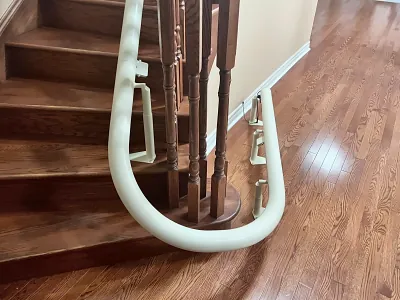
Handicare Freecurve rail looping round the newel post at the bottom landing of a hardwood staircase.
Room beside the bottom step

Parking curve

The rail turns 90 or 180 degrees at the bottom, so the chair waits off the stairs and out of the walkway. The Flow X and the Freecurve offer one, and the 2000 could be ordered with one.

Freecurve. From a home we fitted.
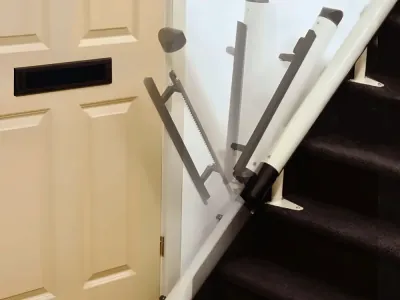
Handicare Freecurve powered hinge beside a front door, the bottom section of rail shown in several positions as it folds up out of the doorway.
A door right at the bottom step

Powered hinge

The bottom piece of rail folds up out of the doorway when the chair is not on it. Offered on the Freecurve, where the chair then parks at a charge point, not on the hinge. The 2000 could be ordered with one.

Freecurve. From a home we fitted.
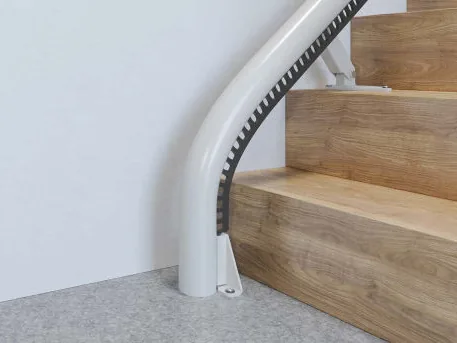
Access BDD Flow X standard drop nose: the rail end curves down to a foot on the floor in front of the bottom step.
A narrow hallway at the foot of the stairs

Drop nose

The rail end curves down close to the floor. On a Flow X it needs about 175 mm (7 in) of floor in front of the bottom step.

What to look at: the rail ends on a foot about 175 mm (7 in) out from the bottom step.

Flow X. Photo: Access BDD.
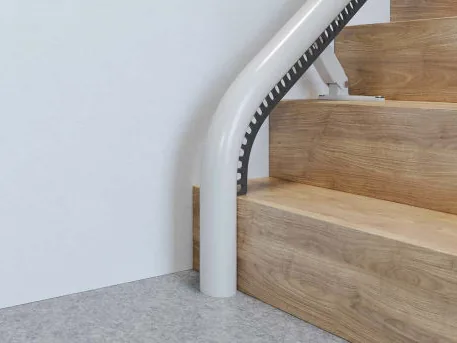
Access BDD Flow X short-start drop nose: the rail end comes down almost straight, close against the bottom step.
Very little floor in front of the step

Short-start drop nose

Flow X only: a rail end that comes down almost straight and needs about 100 mm (4 in) from the bottom step.

What to look at: the rail comes down almost upright, close to the bottom step.

Flow X. Photo: Access BDD.

Less than about 4 in (100 mm) of floor in front of the bottom step? Tell us when you book: we need to see it before we suggest anything.

From our installs

No two of these rails are the same shape

Photos from homes we have fitted. Each caption says what you are looking at.

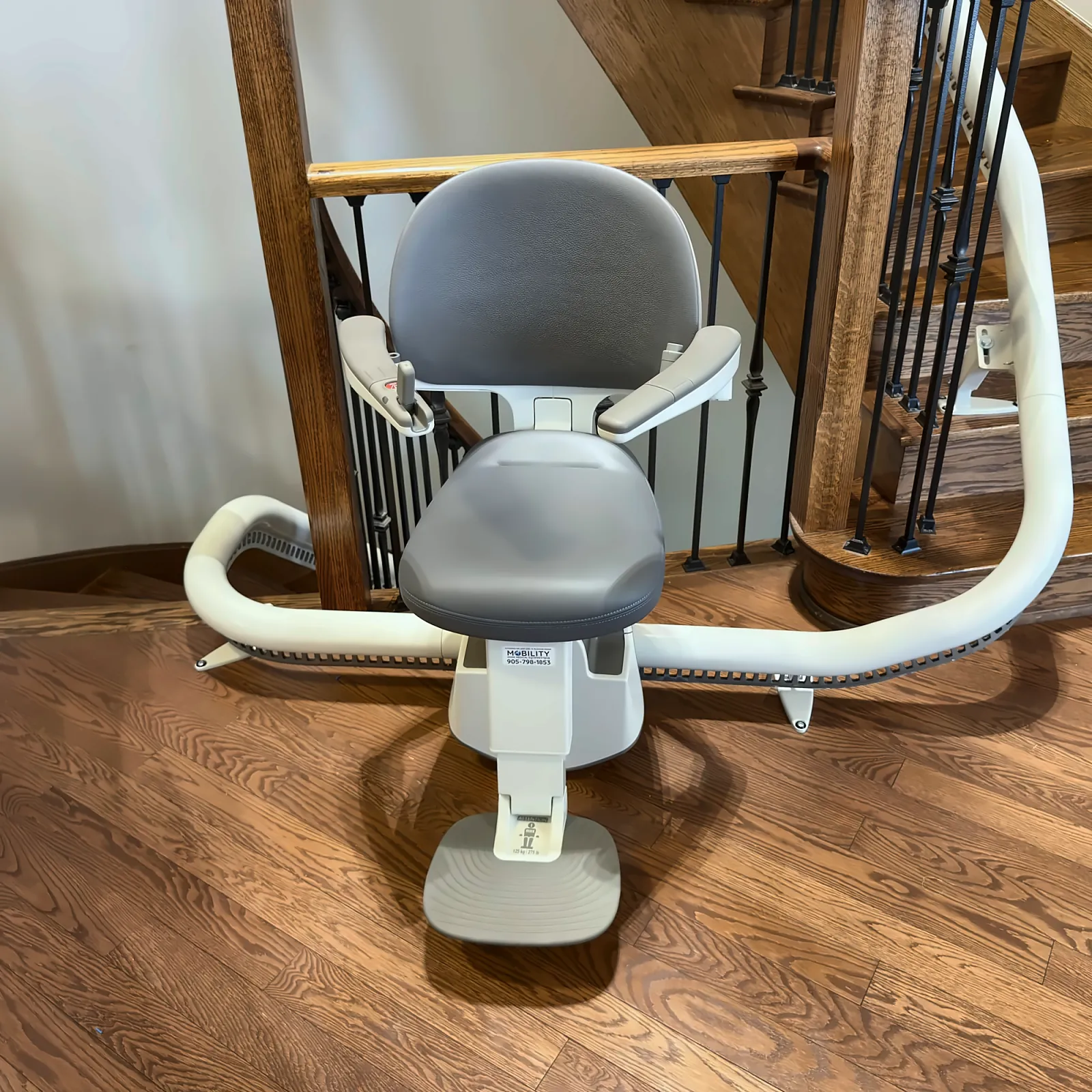
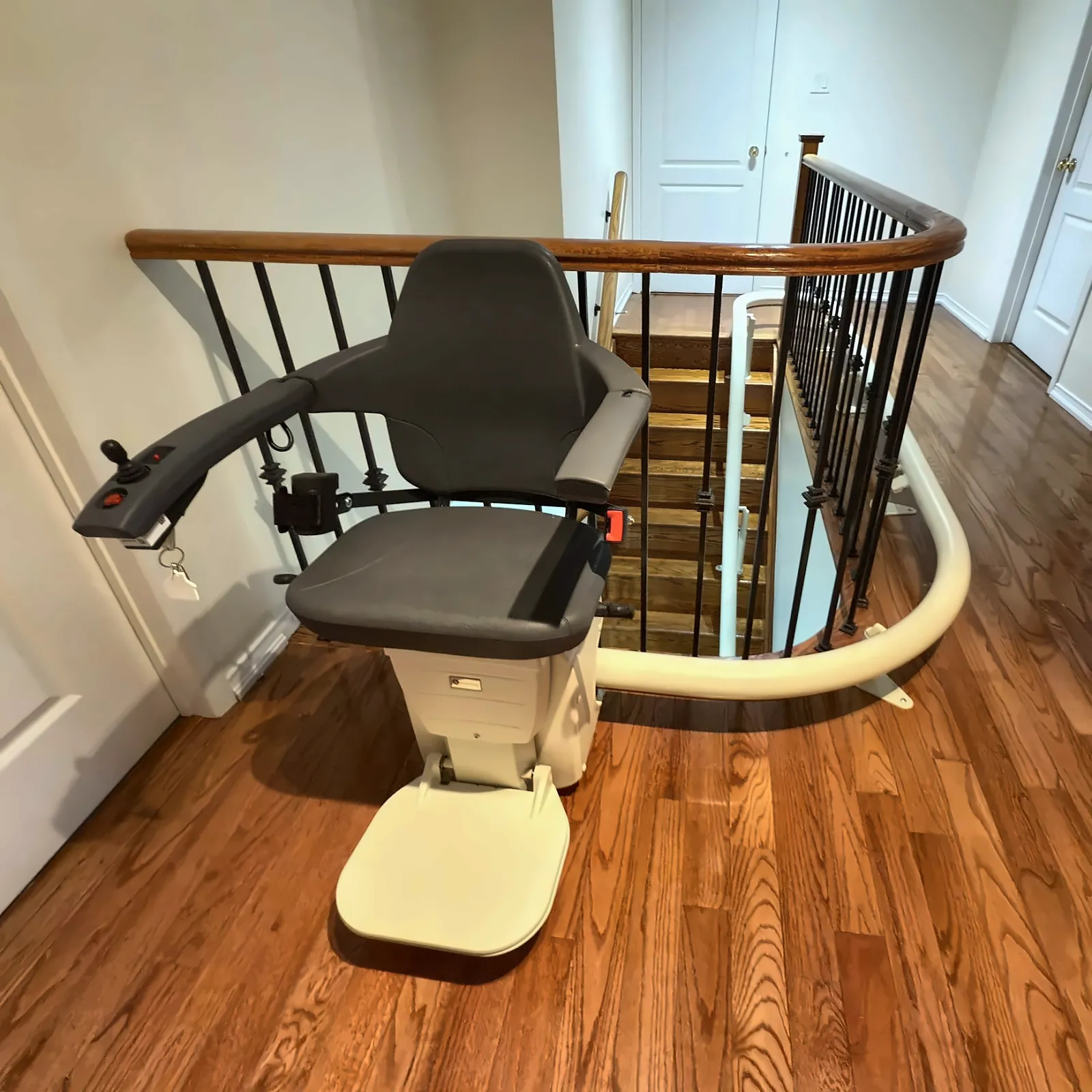
  • Flow X curved stairlift with a grey seat at the bottom of a curved oak staircase, its rail wrapping round the newel post.
    Flow X: rail wraps the newel post at the bottom The chair waits on the floor, not on the first step.
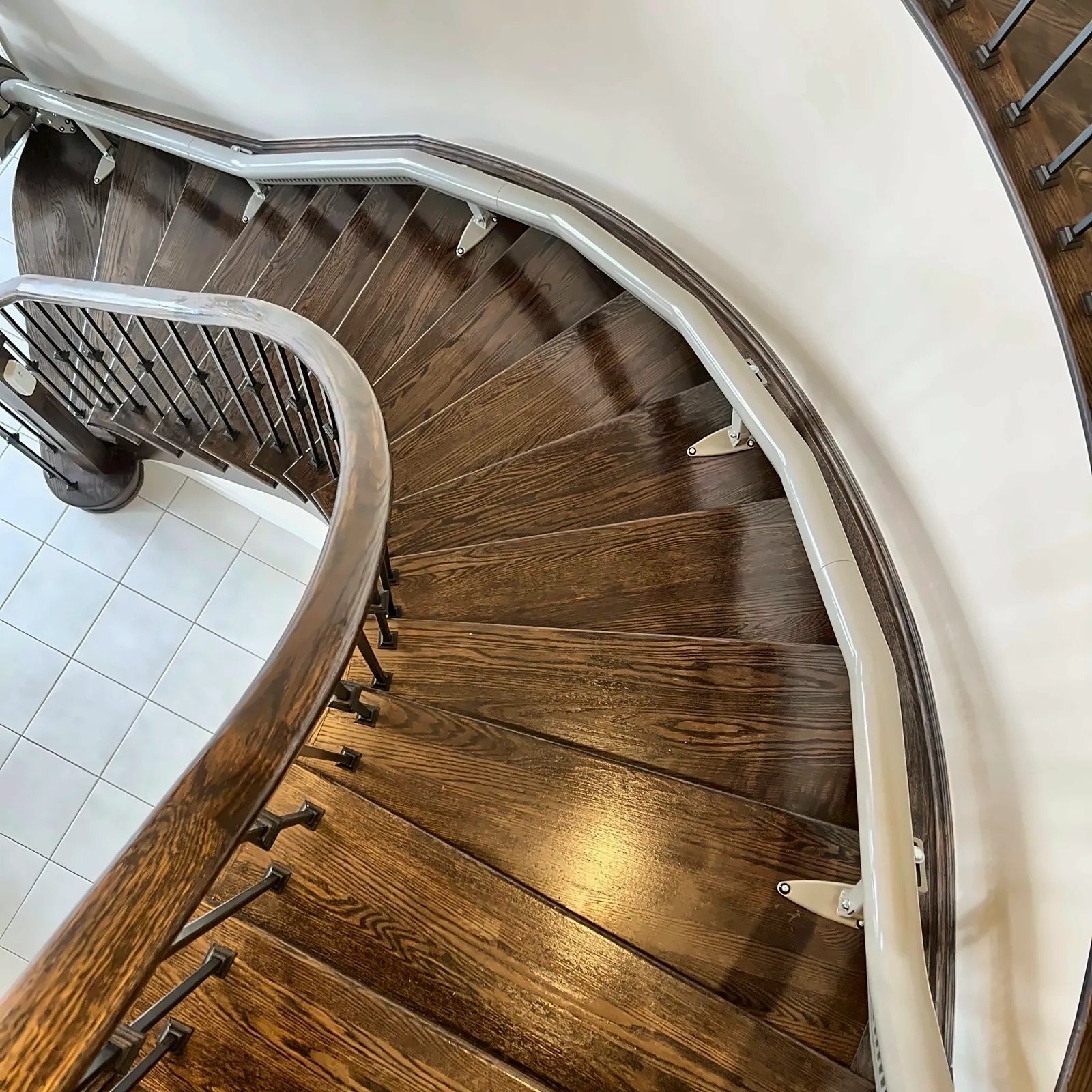
  • Looking down a dark oak curved staircase as the Flow X rail follows the outer wall through the turn.
    Flow X: rail on the outer wall of a spiral Seen from above, it follows the wall all the way through the turn.
  • Handicare Freecurve stairlift with a charcoal seat at the top landing, its cream rail curving round the stairwell.
    Freecurve: top landing, rail round the stairwell The rail carries on past the top step, so the chair stops over the landing floor.
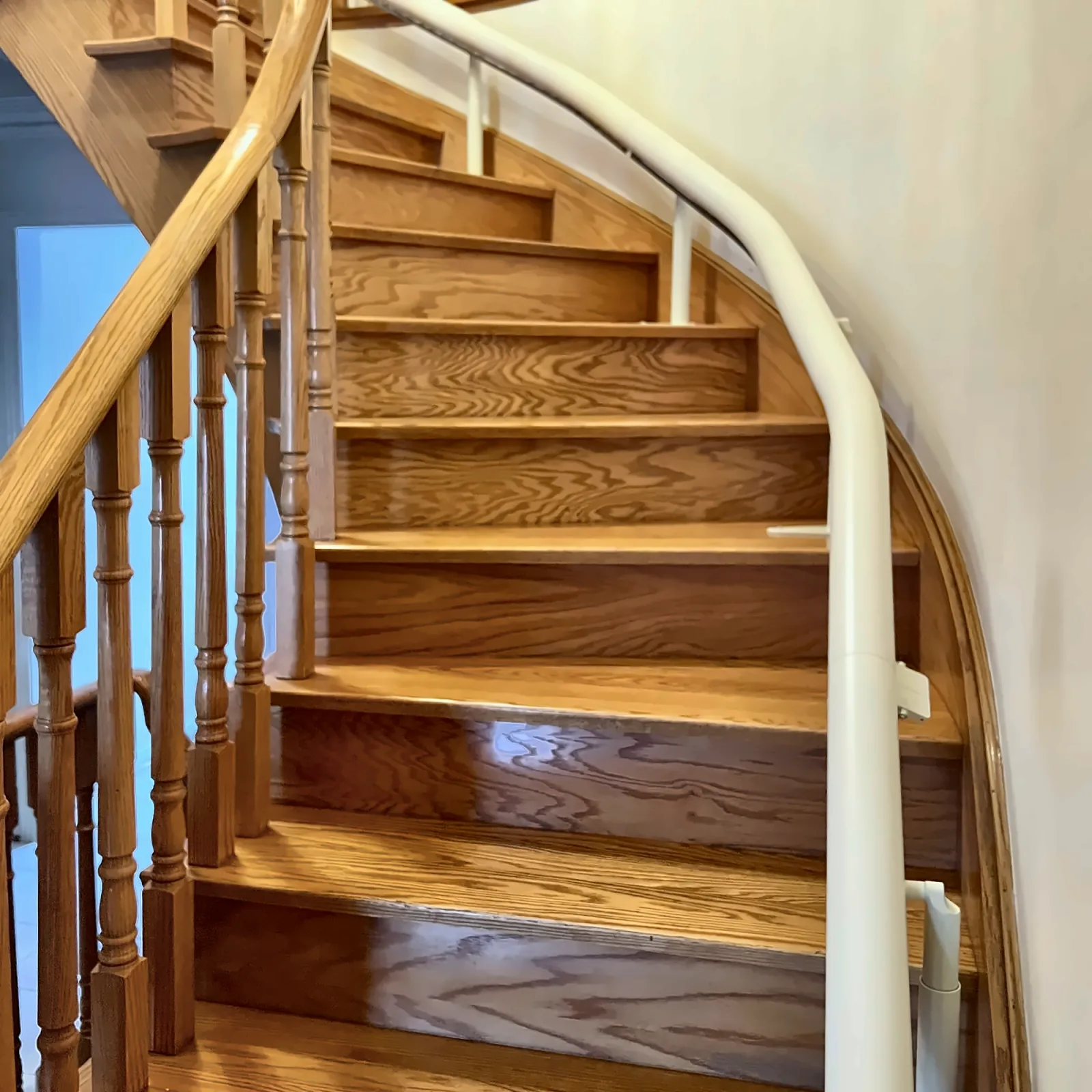
  • Handicare Freecurve single-tube rail rising along the wall of an open curved oak staircase.
    Freecurve: open curved staircase, wall side One tube on the wall side leaves the banister side of the treads clear.
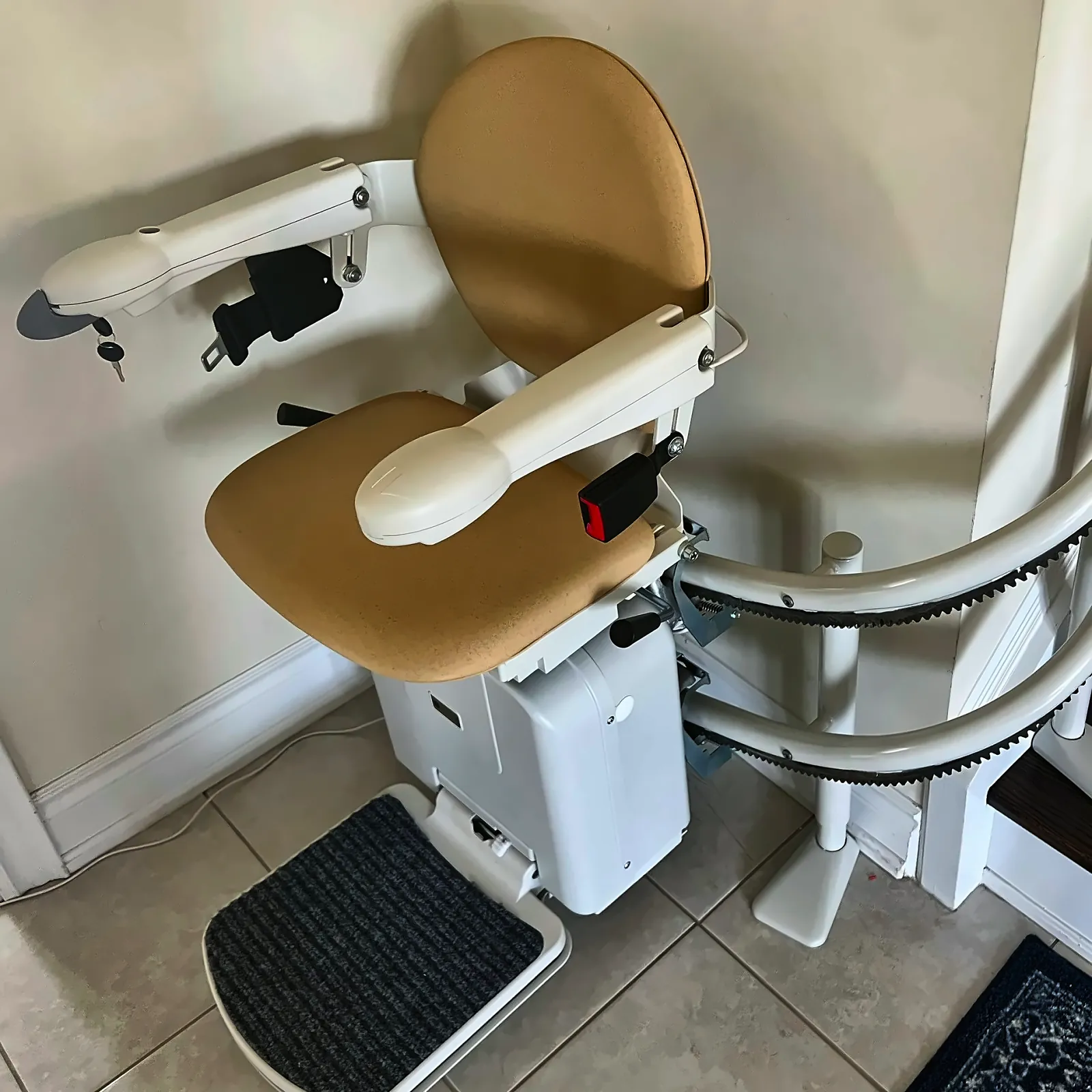
  • Handicare twin-rail curved stairlift with a tan seat at the bottom of the stairs, its twin-tube rail curving up the staircase.
    Handicare twin rail: bottom of a turning staircase Two tubes instead of one.
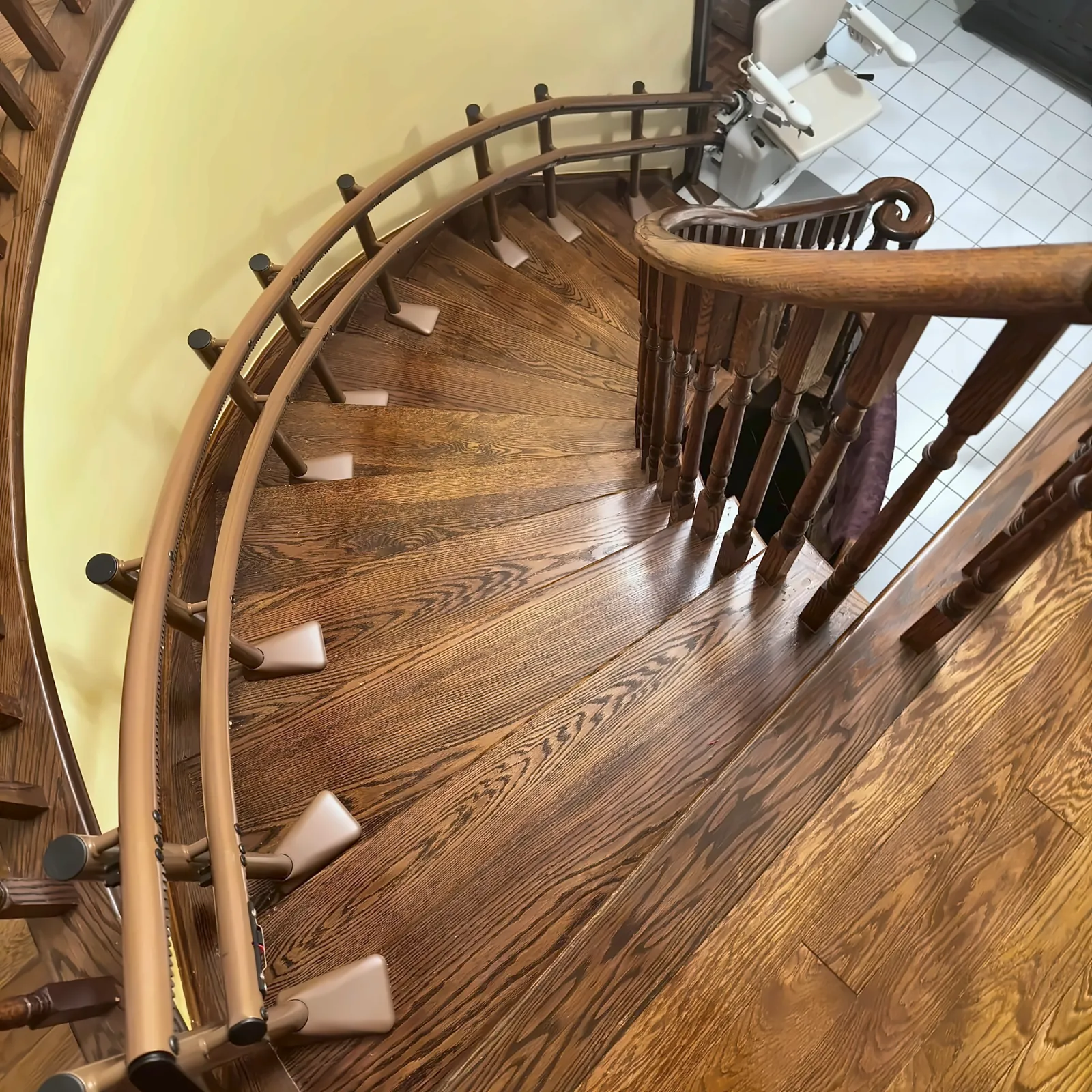
  • Brown Handicare twin-tube rail following a curved hardwood staircase.
    Handicare twin rail: brown rail on a curved staircase The twin tubes follow the curve of the hardwood stairs.
Questions

Ask us anything. Most answers are short.

Pick a topic or type your question in your own words. If we have not written the answer down yet, send it to us and we reply within one business day.

How much does a curved stairlift cost?

We quote each curved stairlift after we measure your stairs, because the rail is made for one staircase. The model, the length of rail, the bends and landings, parking, a hinge, the seat and swivel options and the installation work all change the price.

What this means for you: The home assessment is free, and the written quote is the price for your stairs. Nothing is ordered until you approve it.

See what happens after you book
Can a stairlift go on my narrow stairs?

It depends on the model and your stairs. Access BDD says the Flow X can go on stairs as narrow as 610 mm (24 in) with its ASL swivel, or 810 mm with straight armrests. The Handicare technical manual gives 690 mm (about 27 in) for a Freecurve with the rail on the outer side of the stairs, and 770 mm (about 30 in) on the inner side.

What this means for you: Measure the narrowest point if you like, but do not rule anything out yourself. We measure the width, the rail side and the folded chair at the free assessment.

Try the stairlift chooser
How steep can the stairs be?

Access BDD rates the Flow X for stairs up to 72 degrees. The Freecurve is rated from 0 to 61 degrees, and Handicare publishes no maximum for the 2000.

What this means for you: You do not need to measure the angle. We do that at the assessment.

Compare the three lifts
There is a door near the bottom step. What then?

There are a few ways to end the rail. A parking curve takes the chair off the stairs, a powered hinge folds the bottom of the rail out of a doorway on the Freecurve (the chair then parks at a charge point, not on the hinge) and could be ordered on the 2000, and a drop nose keeps the rail end low. On a Flow X, the standard drop nose needs about 175 mm (7 in) of floor in front of the bottom step and the short-start drop nose about 100 mm (4 in).

What this means for you: If you can, measure from the bottom step to the nearest door or wall. Less than about 4 in (100 mm)? Tell us, because we need to see it.

See the rail ends, drawn and photographed
Can it go on a spiral staircase, or stop at a landing?

All three are built for stairs that turn, wind or spiral. For a landing where the rider gets off partway up, the Flow X has extra stop positions and the Freecurve can stop with Tap2Floor and a powered swivel. Handicare does not document a stop partway up for the 2000.

What this means for you: Tell us where the rider gets on and off. The rail is drawn to match your stairs.

Try the stairlift chooser
How much weight can it carry?

The Flow X and the Freecurve each carry one rider up to 275 lb (125 kg). The special-order Handicare 2000 was rated 250 lb, or 300 lb with its heavy duty version, if a unit can still be supplied.

What this means for you: If the rider is over 275 lb (125 kg), tell us when you book so we check the special-order route first.

See the Handicare 2000
Can the rider stay in a wheelchair, or stand?

A stairlift carries one seated rider, who moves from a wheelchair onto the seat. None of our curved lifts is a standing lift. If the rider needs to stay in the wheelchair, a platform lift is the one to look at. The special-order Handicare 2000 had a perch seat for a rider who cannot bend fully.

What this means for you: Tell us how the rider gets on and off a chair today. We check the transfer at the assessment.

See porch and platform lifts
Can a stairlift go on outdoor steps?

Not one of these curved lifts. The Flow X and the Freecurve are indoor lifts, and the outdoor version of the 2000 is discontinued. For a straight run outside, the Handicare 1000 has an outdoor package for suitable sites, and for front steps a porch lift is another option.

What this means for you: Tell us about the steps, the weather they face and who uses them. We look at the outdoor options with you at the assessment.

See porch and platform lifts
Does it still work when the power goes out?

All three run on batteries that charge from household power. Access BDD's manual gives 10 journeys on battery after a mains failure for the Flow X, Handicare says the Freecurve can be used several times during an outage, and the 2000 manual gives at least 10 trips before recharging.

What this means for you: Leave the chair parked at a charge point, normally at the top or bottom of the stairs, so the batteries stay full for when the power goes out.

Compare the three lifts
Do I need an outlet near the stairs?

Yes. The lift charges from a household outlet near the rail. We look at where yours is at the assessment.

What this means for you: No outlet close to the stairs? Mention it when you book.

Book the free home assessment
Will installing it damage my stairs?

The Flow X and Freecurve rails are fixed to the stair treads with supports, not to the wall. At the assessment we check the stair structure and where the supports can be fixed.

What this means for you: Ask us to show you where the supports would sit on your treads.

See rails we have fitted
Can the rest of the family still use the stairs?

Yes. On the Flow X and the Freecurve the seat, arms and footrest fold up when the lift is not in use, and the Flow X can fold itself with its automatic folding option. A parking curve can also take the chair off the stairs altogether.

What this means for you: Tell us who else uses the stairs every day. We plan where the chair parks around them.

See the parking options
Can I keep children or visitors from riding it?

Yes. A key switch is standard on the Freecurve and the 2000, to stop the lift being used without the key. The Flow X offers a key lock as an option, though its call-and-park stations still work while it is locked.

What this means for you: Keep the key with the rider, or somewhere the children cannot reach.

See the three lifts
What safety features does it have?

Each lift has its own set. The Freecurve has obstruction sensors on the footrest and carriage, an overspeed governor, a retractable belt, a non-skid footrest, keyed operation and an emergency stop. The Flow X has armrest position detection, anti-squeeze sensors under the seat, overspeed control, self-levelling, an emergency lowering button and an emergency stop.

What this means for you: Features do not replace a check of the rider. At the assessment we watch how the rider gets on and off and uses the controls.

Compare the three lifts
Is there funding for a stairlift?

March of Dimes Canada lists stairlifts among the home adaptations its Home and Vehicle Modification Program can fund for eligible Ontario residents. For a custom or curved lift, the application asks for photos before installation, drawings and measurements.

What this means for you: Apply before anything is installed. The program decides who qualifies and how much, not us.

Read about March of Dimes funding
Does ADP cover stairlifts?

Ontario ADP does not cover stairlifts. Separate insurance, disability benefits or other programs may apply to your situation. Check those programs directly before ordering.

What this means for you: Ask us about March of Dimes and the other routes when you book. Apply before anything is ordered.

Read about March of Dimes funding
How long does it take to get one?

The rail is made after you approve the quote. Handicare says a Freecurve rail is made in a few weeks and installed in a few hours to a full day, and Access BDD says a curved Flow X is typically installed in around half a day.

What this means for you: Your written quote gives the dates. For a special-order Handicare 2000, the first step is checking a unit can be supplied.

See what happens after you book
How often does it need a service?

It depends on the model. For the Freecurve, Handicare requires a service at least once a year, or at least twice a year where the lift runs over more than two floors or has more than two users. Ask us the schedule for the model you choose.

What this means for you: For the Freecurve, regular service by an Authorized Savaria Dealer is also a condition of Savaria's warranty.

Stairlift service and repairs
Which warranty applies to my lift?

It depends on the model and the unit. For the Freecurve, Savaria's North American warranty covers parts for 24 months and the motor and gearbox for 10 years indoors. It is parts only, not transferable, and subject to installation and regular service by an Authorized Savaria Dealer. For the Flow X and a special-order 2000, ask us for the written warranty for your build.

What this means for you: The warranty that applies to your lift is written in your quote.

Stairlift service and repairs
Can I see one before I decide?

Our Etobicoke and Brampton showrooms are open Monday to Friday, 9:00 am to 5:30 pm, and Saturday, 10:00 am to 2:00 pm. Contact us before you travel to check which models you can see.

What this means for you: A curved rail is made for your stairs, so the free home assessment is where you see how it would sit in your home.

See the showroom addresses
Which curved stairlift should I look at first?

It depends on the width and angle of the stairs, the space in front of the bottom step, any landing you stop at and what the rider needs. The chooser on this page sorts the three lifts from five answers.

What this means for you: Use the chooser for a first answer. We confirm the model at your free home assessment.

Try the stairlift chooser
Is the Handicare 2000 still available?

Handicare has discontinued the 2000. We can ask Savaria whether a new or refurbished unit can be supplied for your home, and we confirm that before you plan around it.

What this means for you: Special order, confirm first. Tell us about the rider when you book, so we check this route first.

See the Handicare 2000
Funding

Help paying for a stairlift is worth asking about

March of Dimes Canada lists stairlifts among the home adaptations its Home and Vehicle Modification Program can fund for eligible Ontario residents. For a custom or curved lift, the application asks for photos before installation, drawings and measurements.

Apply before anything is installed. The program decides who qualifies and how much, not us.

After you book

You see a written quote before anything is made

The steps are the same for all three lifts. We confirm the dates in your quote.

  1. We measure your stairs

    At your home, free. We look at the turns, both landings, nearby doors and the power outlet, and talk through who will ride and how they get on and off.

  2. You get a written, itemized quote

    It names the model, the rail route, the seat and options, and the installation work.

  3. You decide

    The rail is made only after you approve the quote. For a special-order Handicare 2000, we first confirm that a unit can be supplied.

  4. We install it and hand it over

    Ask us to show you the controls, the swivel, parking and charging before we leave.

Free home assessment

Book your free home assessment

Tell us about the turns, the landings and who will ride. We measure your stairs at home, free, and send a written quote before anything is ordered.

Book a free home assessment

We need a phone number or an email to reply. One is enough.

We reply within one business day. Prefer to talk? Call (905) 798-1853.

Written by Mobility Specialties. Model figures come from the makers' documents. Sources read : Access BDD Flow X, Flow X order form, Savaria Handicare Freecurve, Freecurve technical manual, Handicare discontinued curved stairlifts, March of Dimes Canada: what HVMP funds, March of Dimes Canada: how to apply. Your written quote confirms the model and configuration for your stairs.